Educating Connor: A Father’s Approach to Math at Home
Companion Guide: Activities, Examples, and Resources.
This guide accompanies the Educating Connor podcast episode. The numbered examples follow the order of the conversation. Follow along as you listen, or use the links below to find an activity you’d like to try with your child.
1. Counting on Fingers
2. Number Line Counting
3. Rush Hour
4. Spider-Man Monopoly
5. Counting On with a Number Path
6. Ten Frame Die
7. Ten Frame Spinners
8. Superhero Make-Ten Game
9. Number Path Make-Ten Game
10. Bedroom Door Basketball Hoop
11. Saving for a Goal
12. Ten Frame Cards
13. Adding Across Ten with Ten Frames
14. Skip Counting Progress Chart
15. Fact Freaks
16. Adding Across Ten
17. Find the Missing Addend
18. Connecting Addition and Subtraction
19. Using Basic Facts with Larger Numbers
20. The Read, Draw, Write Process
21. Learning Money Exchanges with Life
22. Arithmetic and Strategy with Parcheesi
23. The Boy Who Loved Math
24. Pencil Word Problem
25. Singapore Math Intensive Practice
26. Spotting Arrays in Everyday Life
27. Times Tables Sprints
1. Counting on Fingers
Conventional Finger Counting
In the United States, numbers one through five are commonly represented using the following finger positions:
1: index finger
2: index & middle fingers
3: index, middle, & ring fingers
4: all fingers except the thumb
5: an open hand
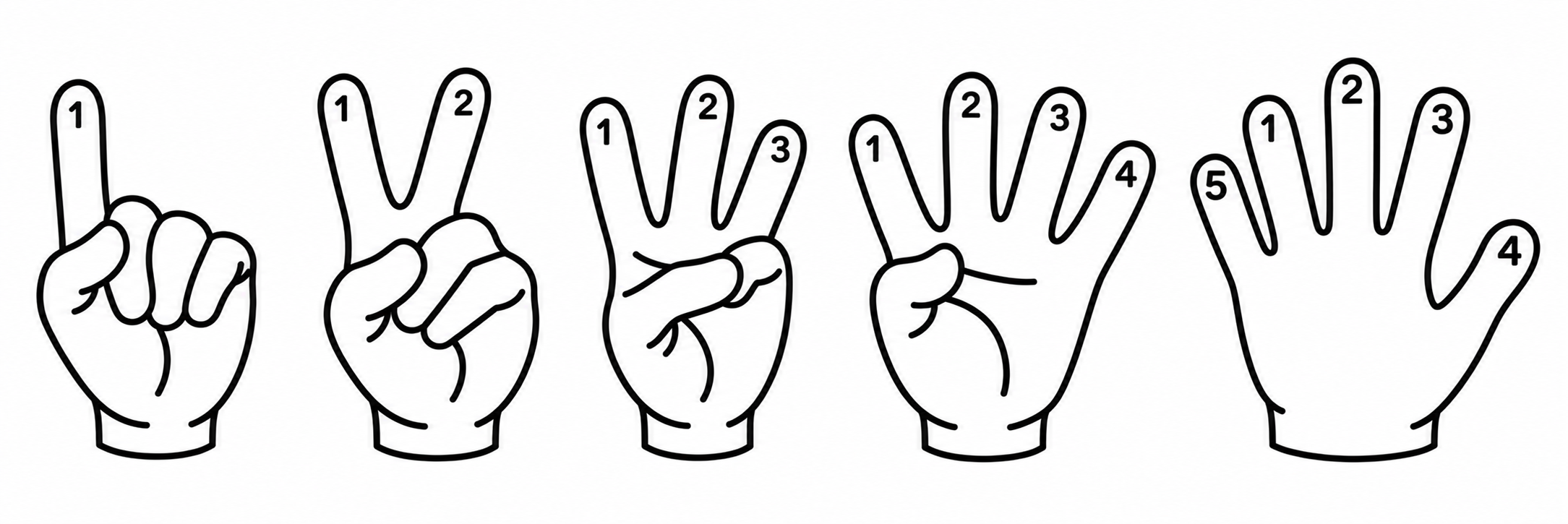
In this sequence, the raised fingers progress from the index finger toward the pinky. At five, the thumb opens on the opposite side, interrupting that progression.
The Sequence We Used
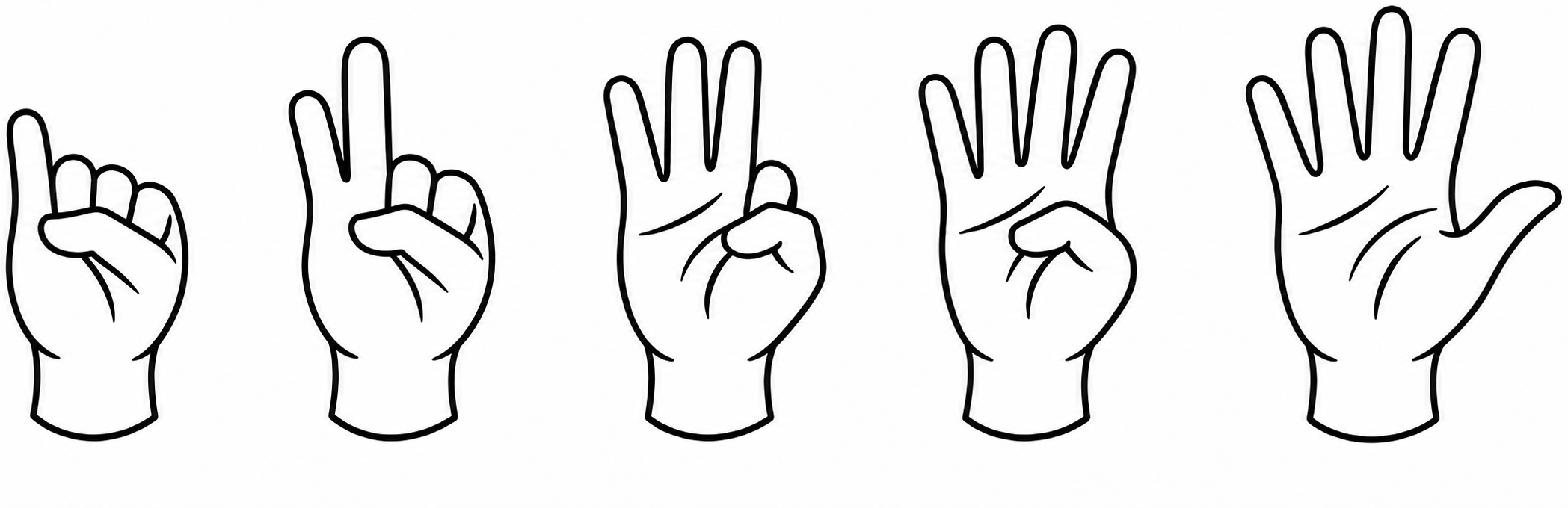
I taught Connor to begin with his left pinky and raise each finger in order toward his thumb. This allowed the numbers to progress from left to right across his field of vision, creating a visual number line.
1: pinky finger
2: pinky & ring fingers
3: pinky, ring, & middle fingers
4: pinky, ring, middle, & index fingers
5: an open hand
Continuing from Six to Ten
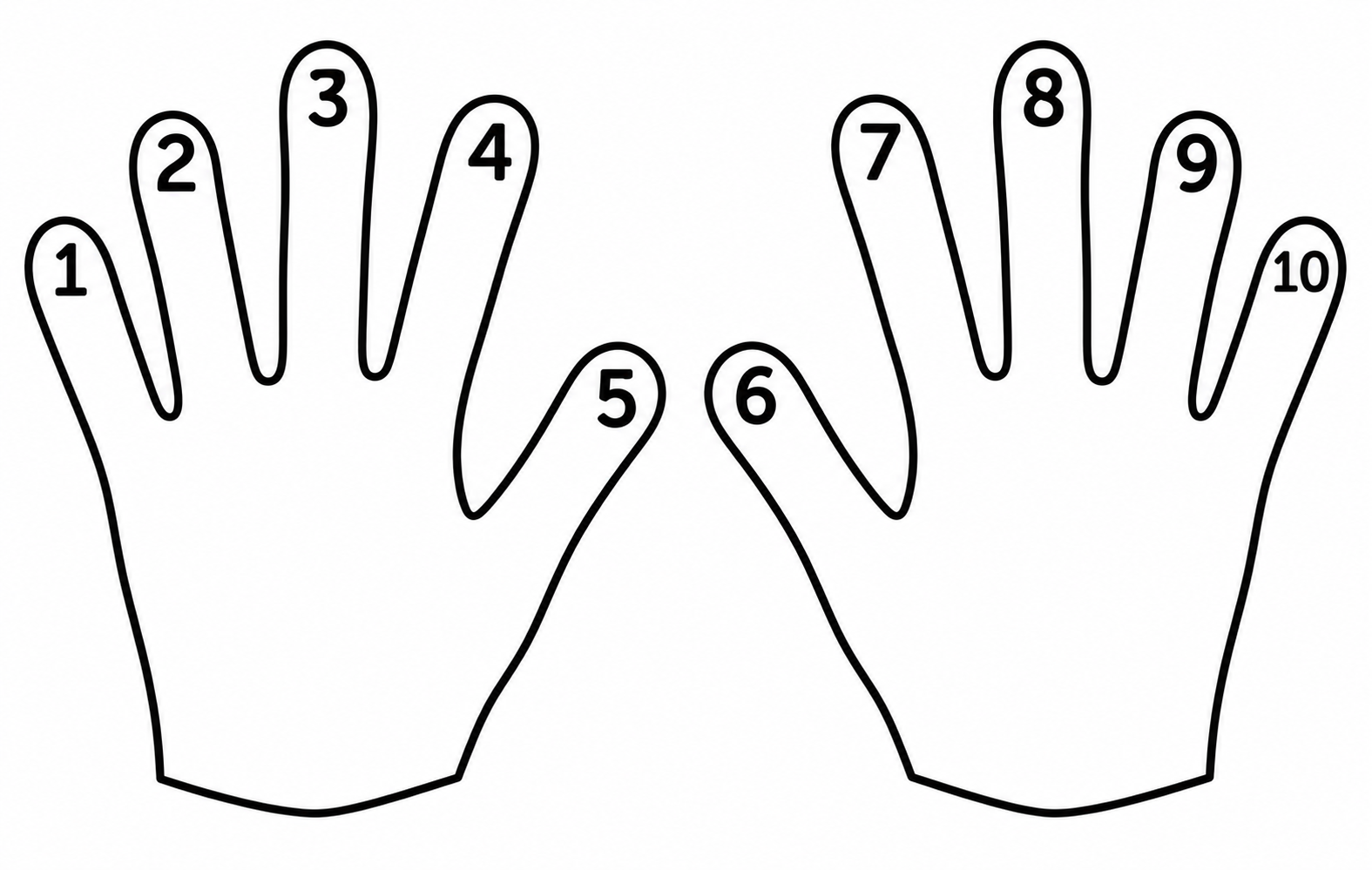
After five, Connor kept his left hand open and continued with his right thumb, raising each finger in order toward his right pinky. The sequence continued from left to right from his perspective.
Numbers six through ten follow in linear order:
6: open hand and thumb
7: open hand, thumb, and index finger
8: open hand, thumb, index finger, and middle finger
9: open hand, thumb, index finger, middle finger, and ring finger
10: Two open hands
2. Number Line Counting
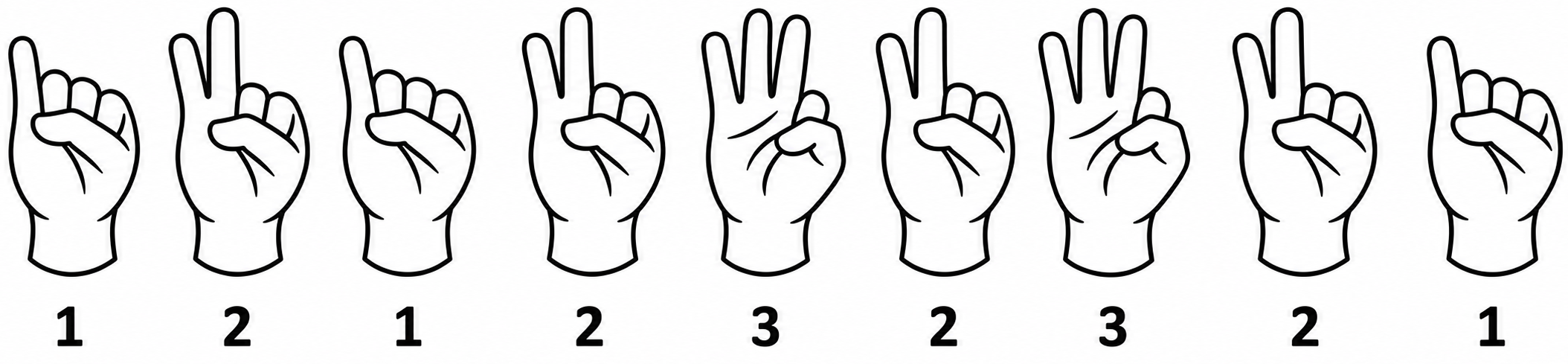
Once students can comfortably transition on the number line between 0 and 3, they are ready to work with the number line to four.
After four, introduce five and continue gradually to ten.
It’s better for a child to count comfortably forward and backward within a smaller range than to count to a higher number in only one direction.”
3. Rush Hour
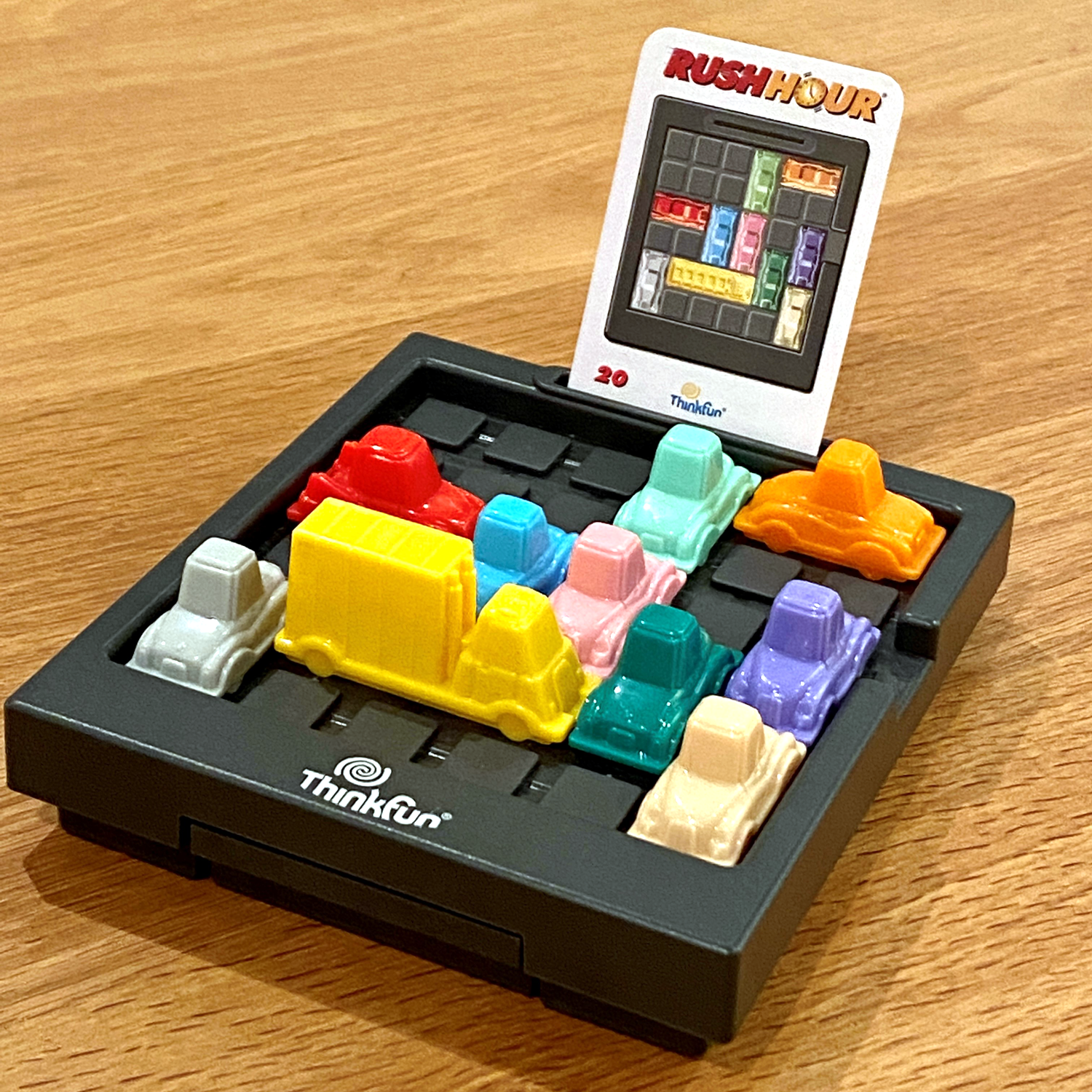
Connor enjoyed these scaffolded logic puzzles, which helped him improve his concentration and develop logical thinking.
4. Spider-Man Monopoly
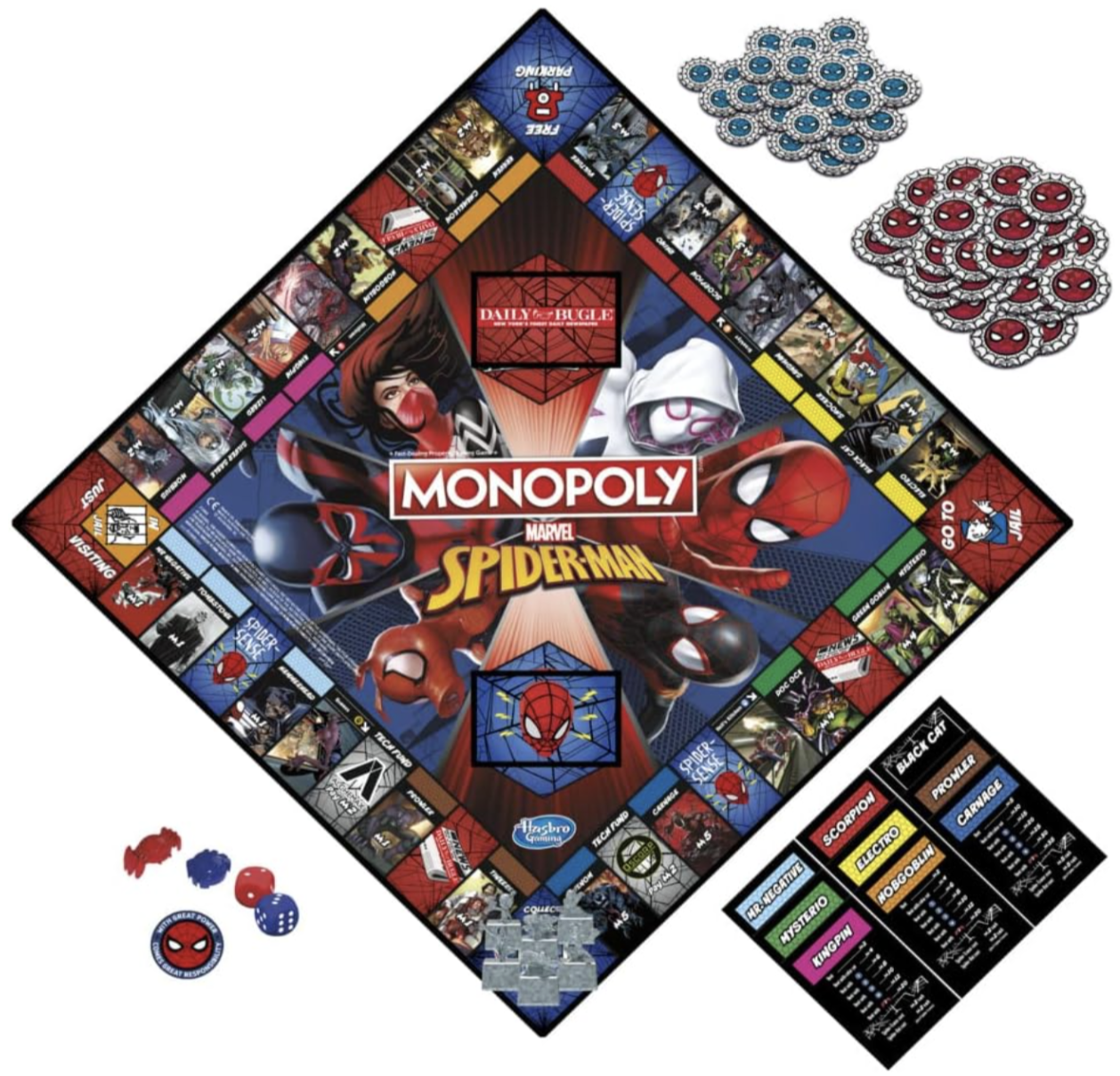
I adapted Spider-Man Monopoly by setting aside the property rules and simply taking turns rolling a die and moving around the board.
Connor practiced recognizing dice patterns and counting on.
Later, we added “Roll Again” and “Lose Your Turn” spaces, prompting him to work out which numbers he hoped to roll and which he wanted to avoid.
5. Counting On with a Number Path
A number path helps children practice counting on.
To solve 7 + 3, place a counter on seven, then move it three spaces to the right, landing on 10. Count each move—not the starting space. This helps children avoid the common mistake of counting seven as the first of the three.
This video shows the next stage of abstraction - counting on at a pictorial, rather than concrete level.
6. Ten Frame Die
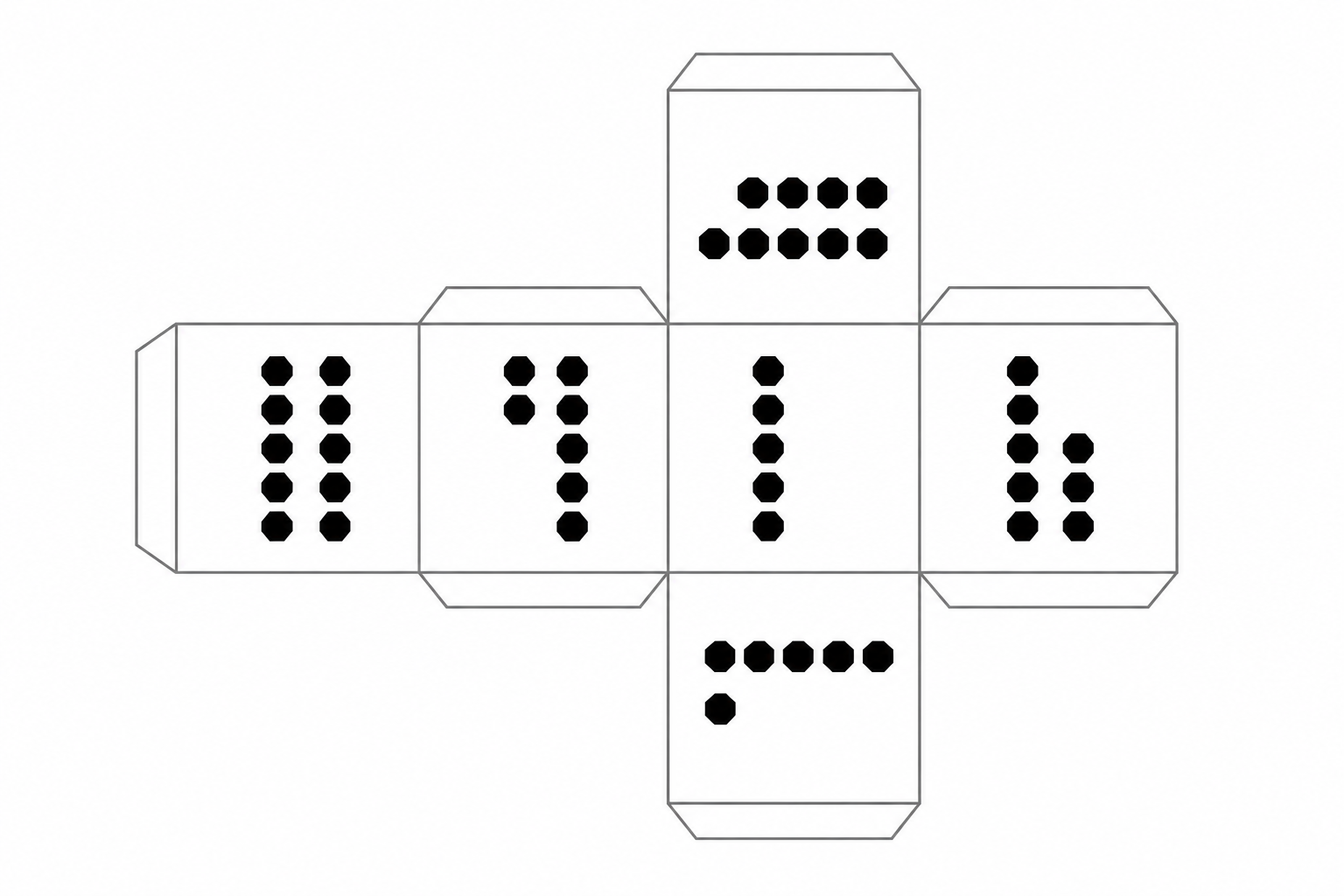
I made a die with ten-frame patterns so Connor could practice recognizing quantities while playing our board game.
Print the template on cardstock, cut it out, and fold it into a cube.
This homemade version wasn’t especially sturdy, so I later switched to a spinner.
7. Ten Frame Spinners
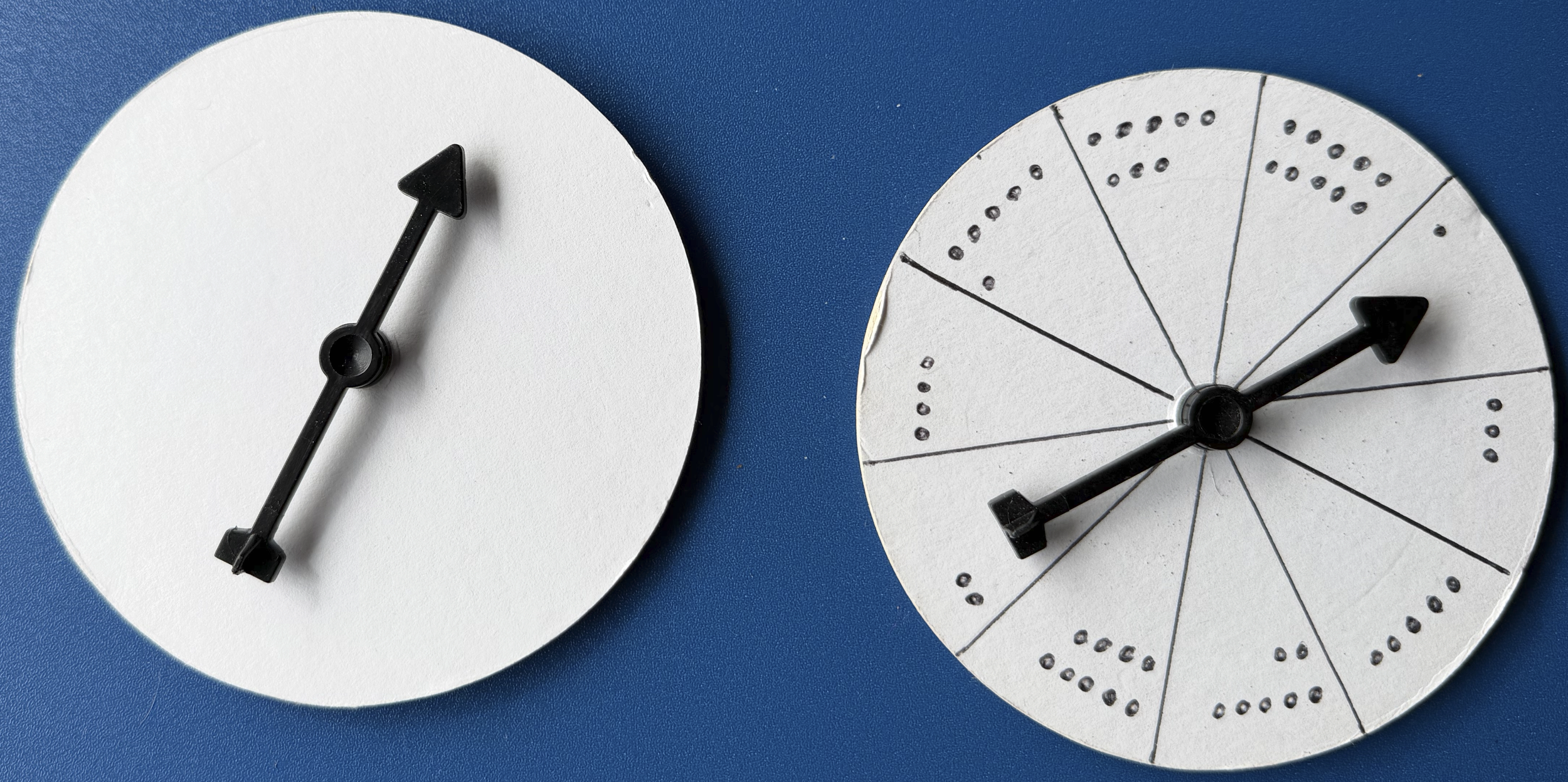
I divided a blank spinner into ten equal sections and drew a different ten-frame pattern in each one.
We used it instead of dice so Connor could practice recognizing quantities from one to ten without counting every dot.
8. Superhero Make-Ten Game
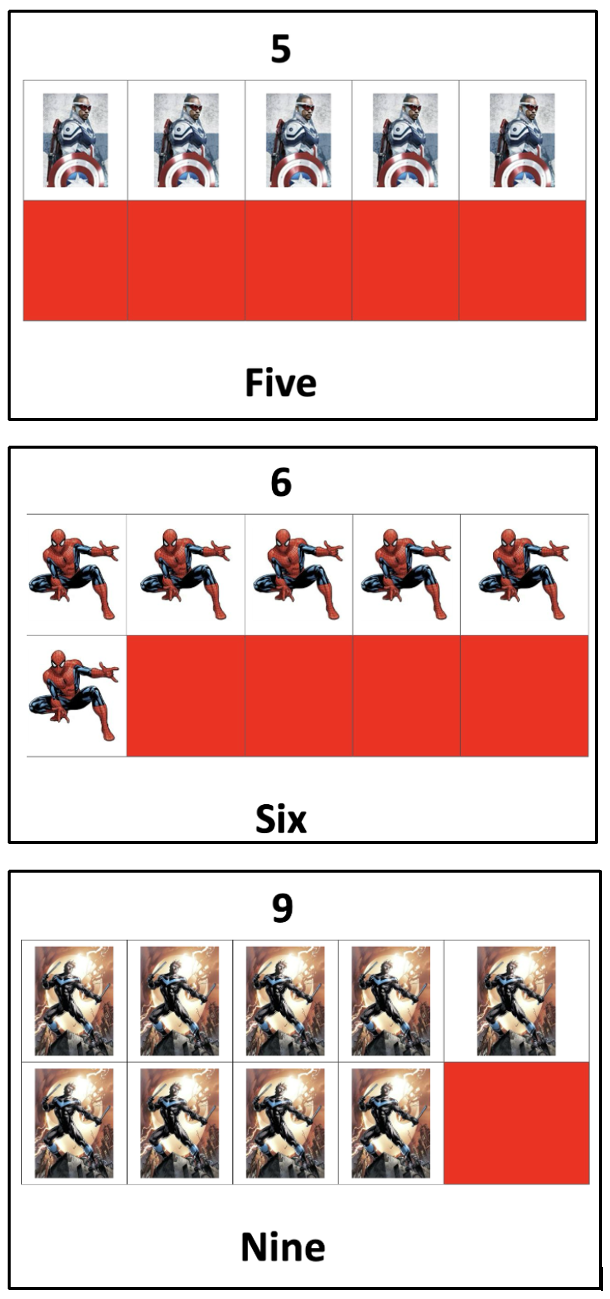
What you’ll need
Ten Frame Cards
Two game pieces.
Spinner numbered 1 to 10.
How to Play
Choose a card, for example 6.
Take turns spinning until a player gets a 6.
Move the game piece to the sixth spot in the ten frame (for this example, the bottom left space).
After reaching six, take one extra spin, trying to get four to make ten. If you don’t get four, leave your piece on six and try again on your next turn.
Each player progresses independently. The other player must still spin the number shown before before placing their piece on the card.
Continue taking turns until one player makes 10.
The first player to reach ten keeps the card.
Repeat with other cards.
The player with the most cards in the end wins.
Parent Prompt: “You’re on six. How many more do you need to make ten?”
9. Number Path Make-Ten Game

What you’ll need
Number Path to 10.
Two game pieces.
A spinner numbered 1–5, or one die with the six covered by masking tape and labeled 0.
How to Play
Place game pieces just before the first space,
Take turns spinning/rolling.
Move the game piece as many spaces as the number spun/rolled.
Continue taking turns. The first player to make ten is the winner.
Note: You must land exactly on ten to win. If you spin or roll a number greater than the spaces remaining, leave your piece where it is and wait until your next turn.
Variation: Use only 1, 2, or 3
Cover the 4, 5, and 6 faces of one die with masking tape. Label them 1, 2, and 3, respectively. The die will now have two faces showing each number.
Take turns rolling.
Move the game piece as many spaces as the number spun/rolled.
Continue taking turns, moving closer to 10 until someone “makes ten”.
Extra Challenge: If a roll would take you past ten, move backward by the full number rolled. For example, if you are on 9 and roll 3, move back 3 spaces to 6.
10. Bedroom Door Basketball Hoop
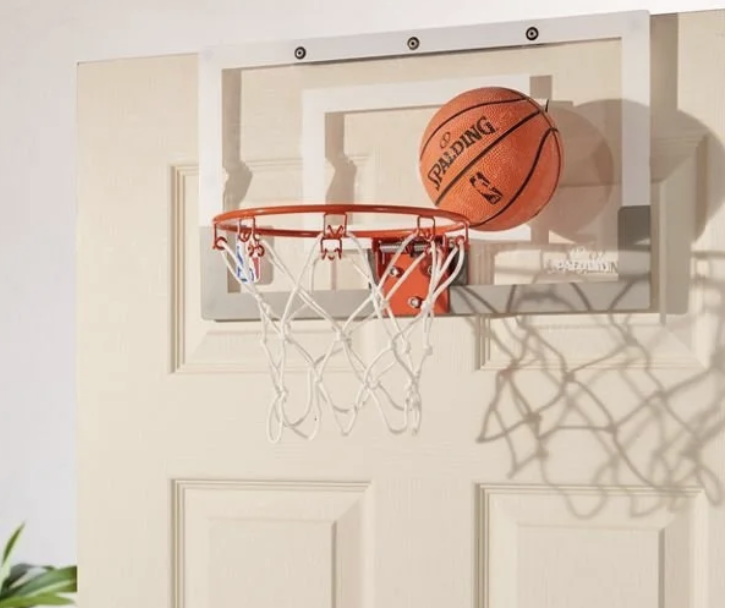
Our bedroom basketball games gave Connor practice adding while keeping score. We started with one point baskets, then introduced one-, two-, and three-point shots. As we played toward higher totals, he became increasingly fluent at adding 1, 2, and 3 to double-digit numbers and recognizing place value patterns within 100.
11. Saving for a Goal
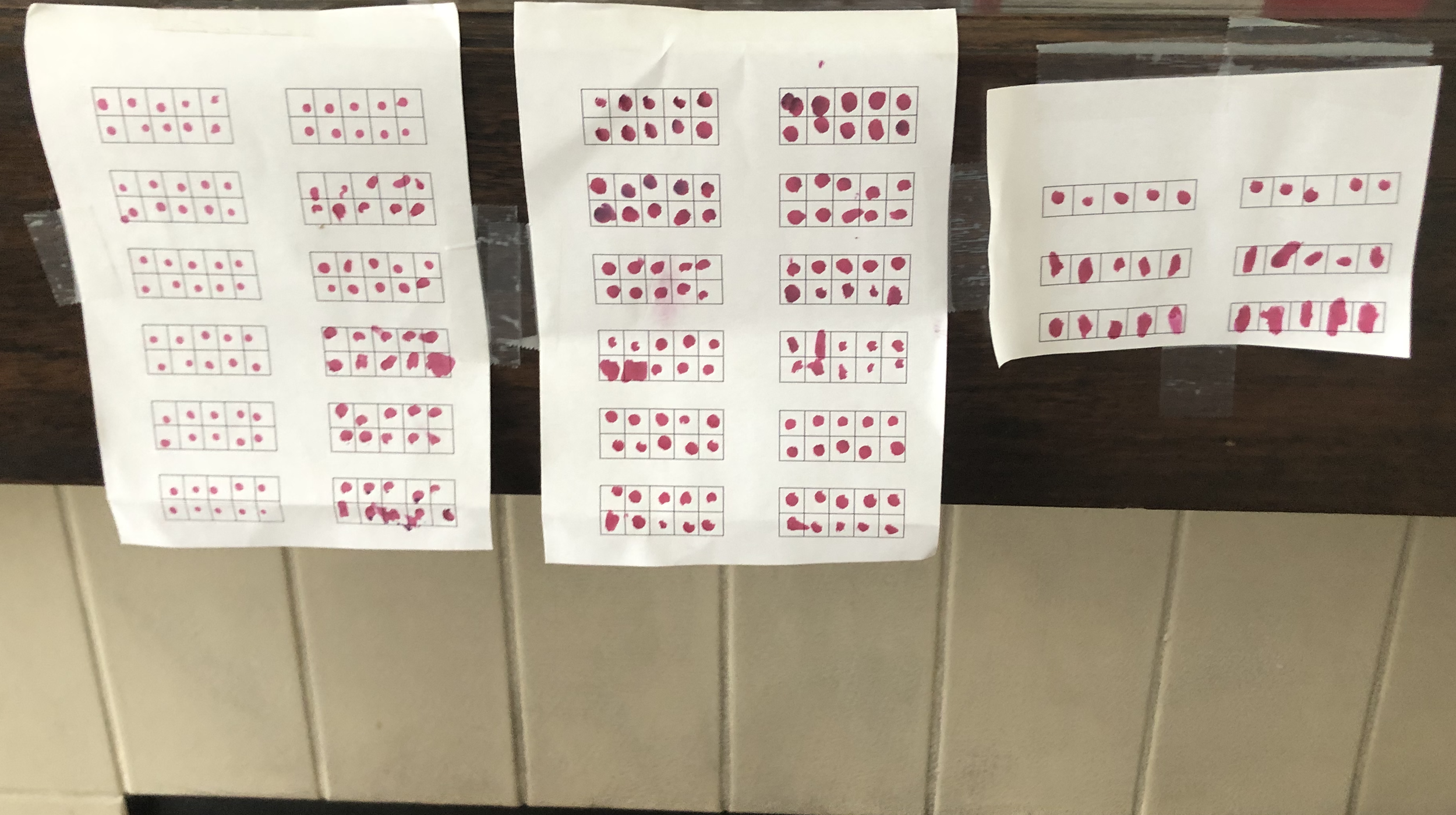
Connor recorded a dot for each can he collected.
Each can earned five cents at the recycling center.
I added another five cents for each can.
Each dot therefore represented ten cents, and each completed ten frame represented one dollar.
To reach the movie’s $27 price, Connor needed to fill 27 ten frames.
Counting Cans
Tallying Results
Reaching His Goal
12. Ten Frame Cards
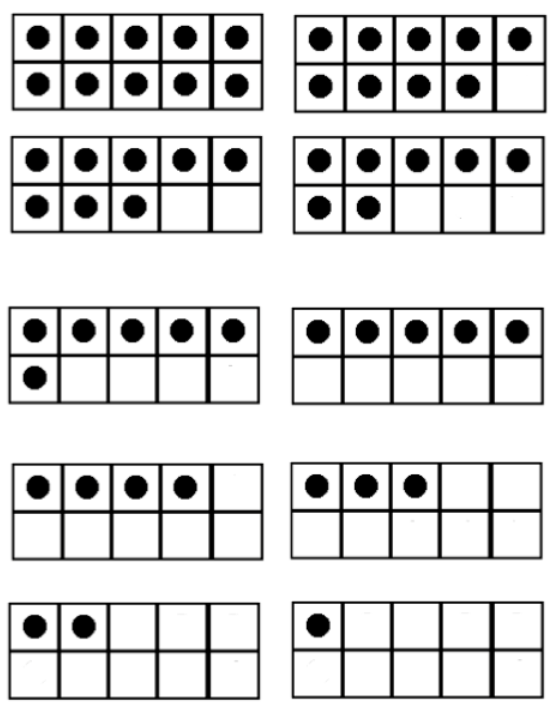
I used ten-frame cards to help Connor recognize quantities without counting every dot.
For each card, I also asked how many spaces were empty.
Seeing eight dots and two empty spaces, for example, helped him connect the arrangement to the fact that eight and two make ten.
13. Adding Across Ten with Ten Frames
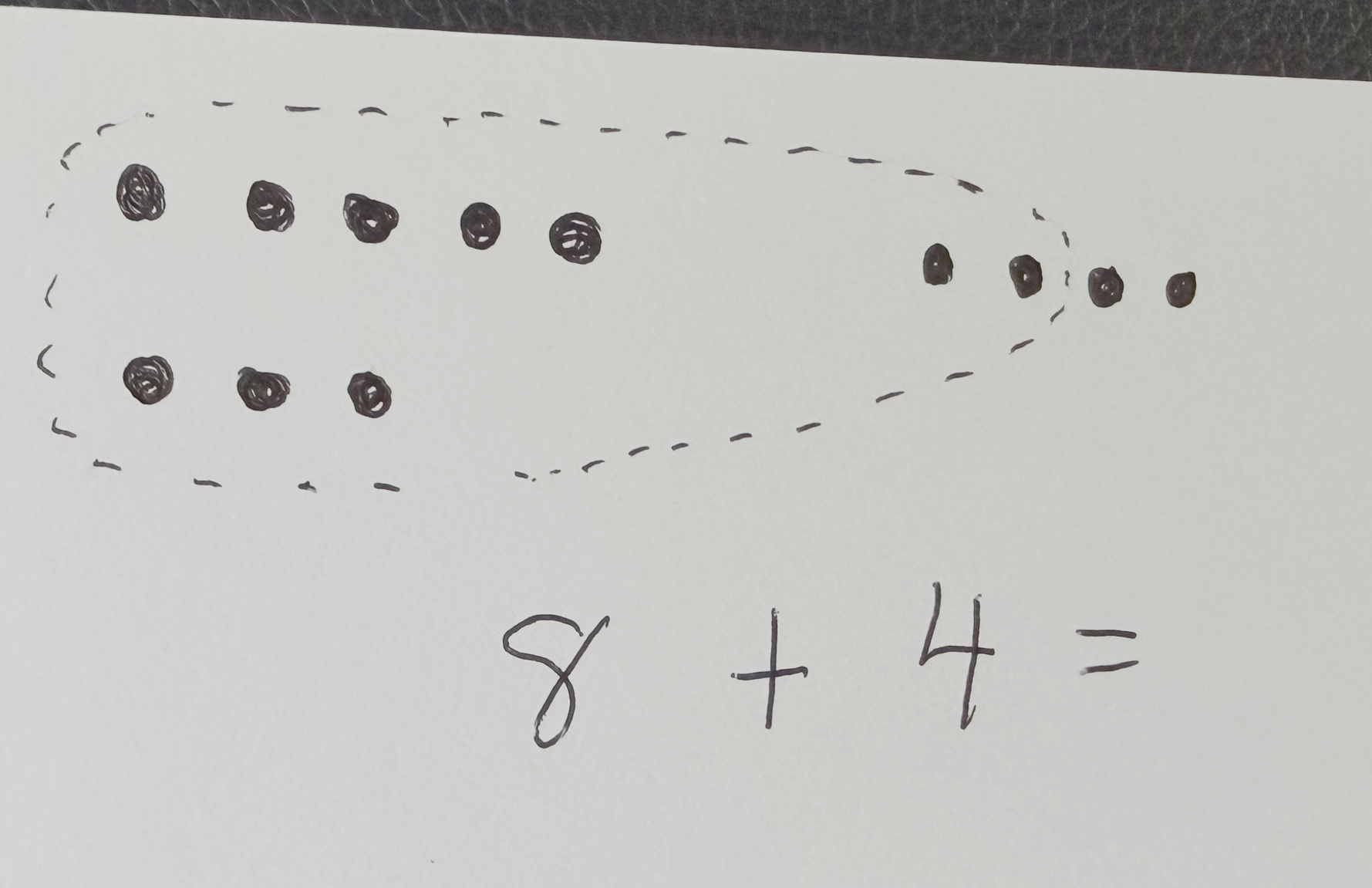
Ten-frame arrangements helped Connor practice skip counting when adding meant crossing ten.
For example, to add four to eight, he could see that two dots completed ten and two more made twelve.
We used these pictures as support until he was comfortable continuing the counting sequence mentally.
In time, he created a mental model of the equations and didn’t need to count on to solve.
14. Skip Counting Progress Chart
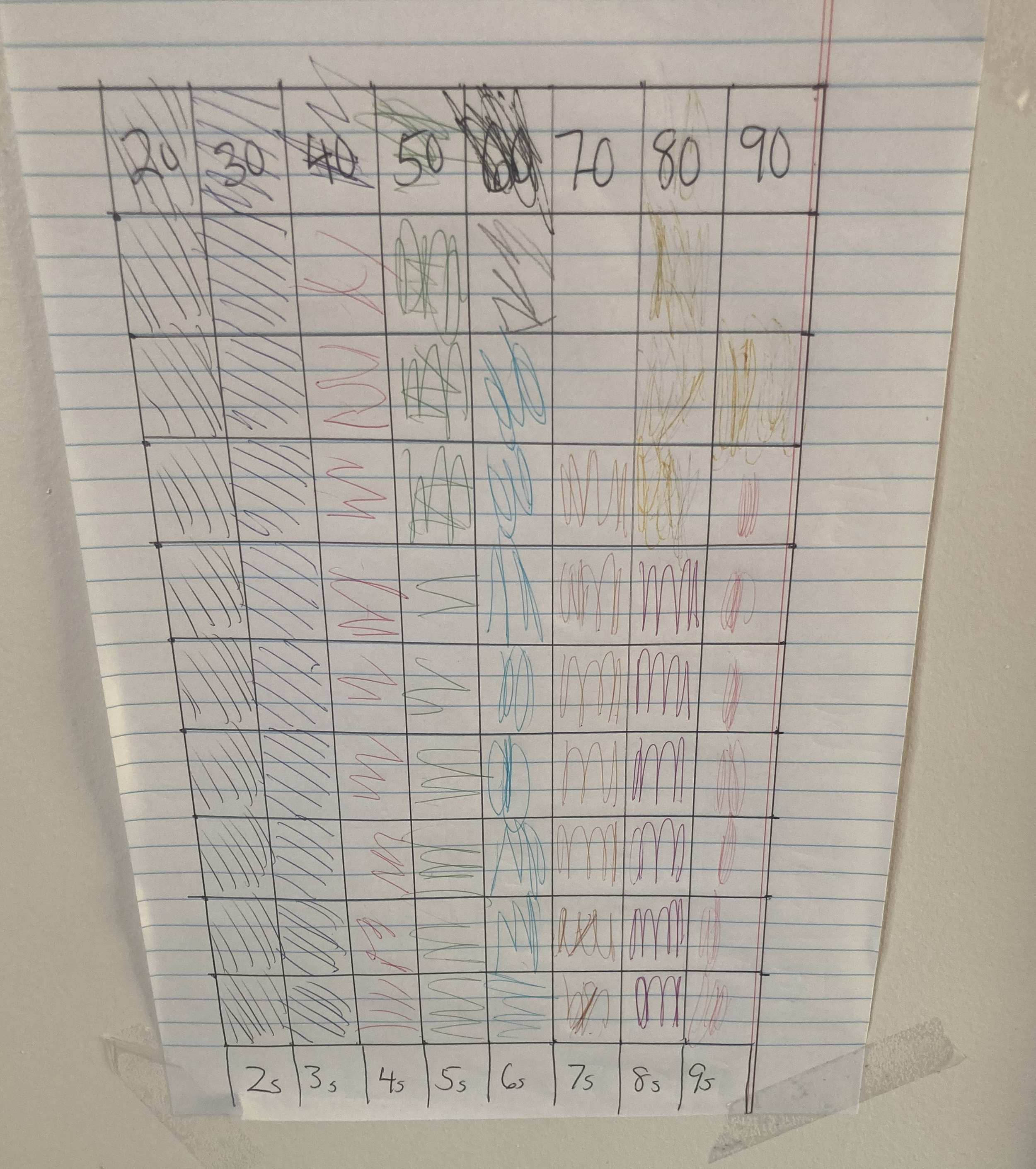
The numbers along the bottom show what Connor counted by: twos, threes, fours, and so on.
Each shaded box marks one additional multiple he could comfortably reach when counting forward and then backward to zero.
The numbers across the top show the final goal for each column. For example, counting by threes to 30 and back.
Completed columns show that he had reached the goal for twos, threes, fours, fives, sixes, and eights.
Two boxes remained in the sevens column. This shows that he could count by sevens to 56 and back to zero but struggled with the 56 to 63 transition.
One box remained in the nines column: he could count by nines to 81 and back to zero but struggled with the 81 to 90 transition.
Counting by Threes
Counting by Fours and Twos
15. Fact Freaks
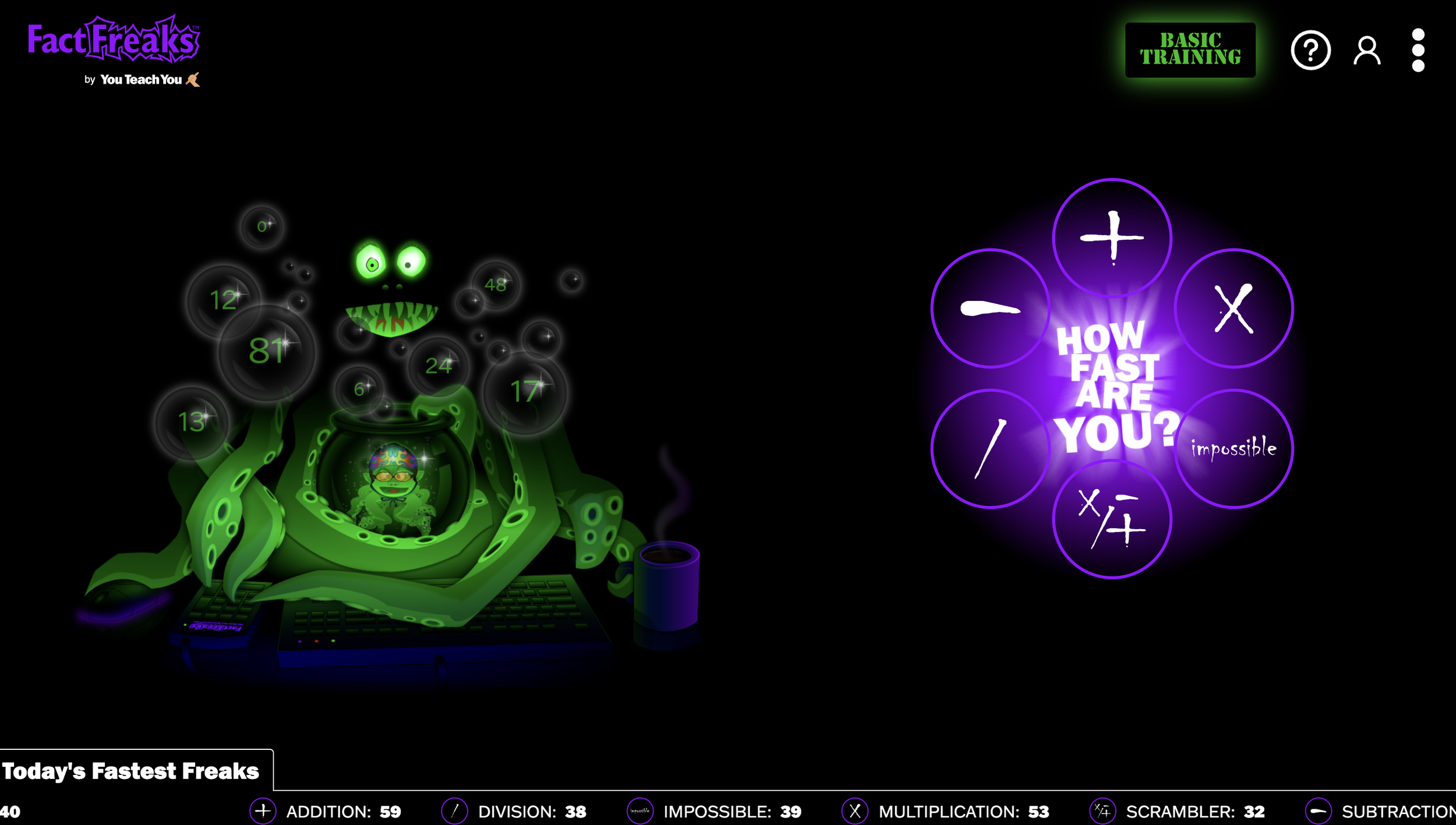
FACT Freaks offers short practice sessions to help children recall basic math facts more easily.
Connor wasn’t interested when I first introduced it, but enjoyed it when we returned to it later. Initially, he called out answers while I typed, allowing him to focus on the math.
16. Adding Across Ten
These three videos demonstrate adding across ten using different representations.
Double Ten Frame
Adding Across Ten: Insert 1
Adding Across Ten: Insert 2
17. Find the Missing Addend
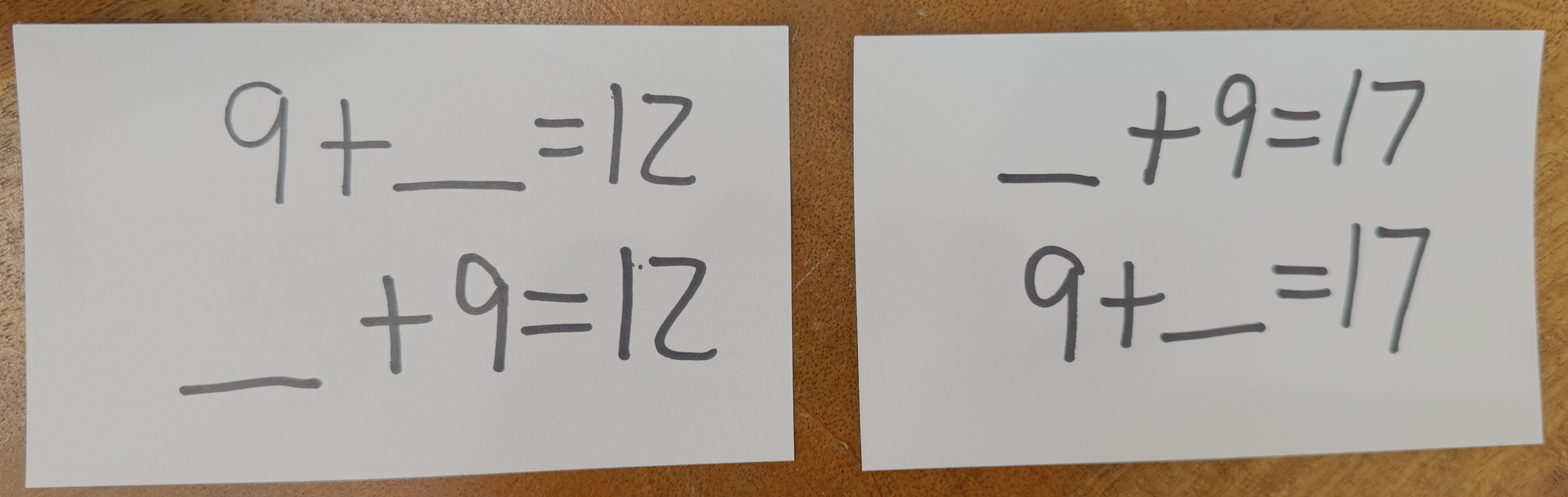
Once Connor could easily recall his adding-nine facts, I used missing-addend problems to practice those same relationships in a different form. For example, knowing that 9 + 3 = 12 helped him recognize the missing number in both 9 + _ = 12 and _ + 9 = 12.
18. Connecting Addition and Subtraction
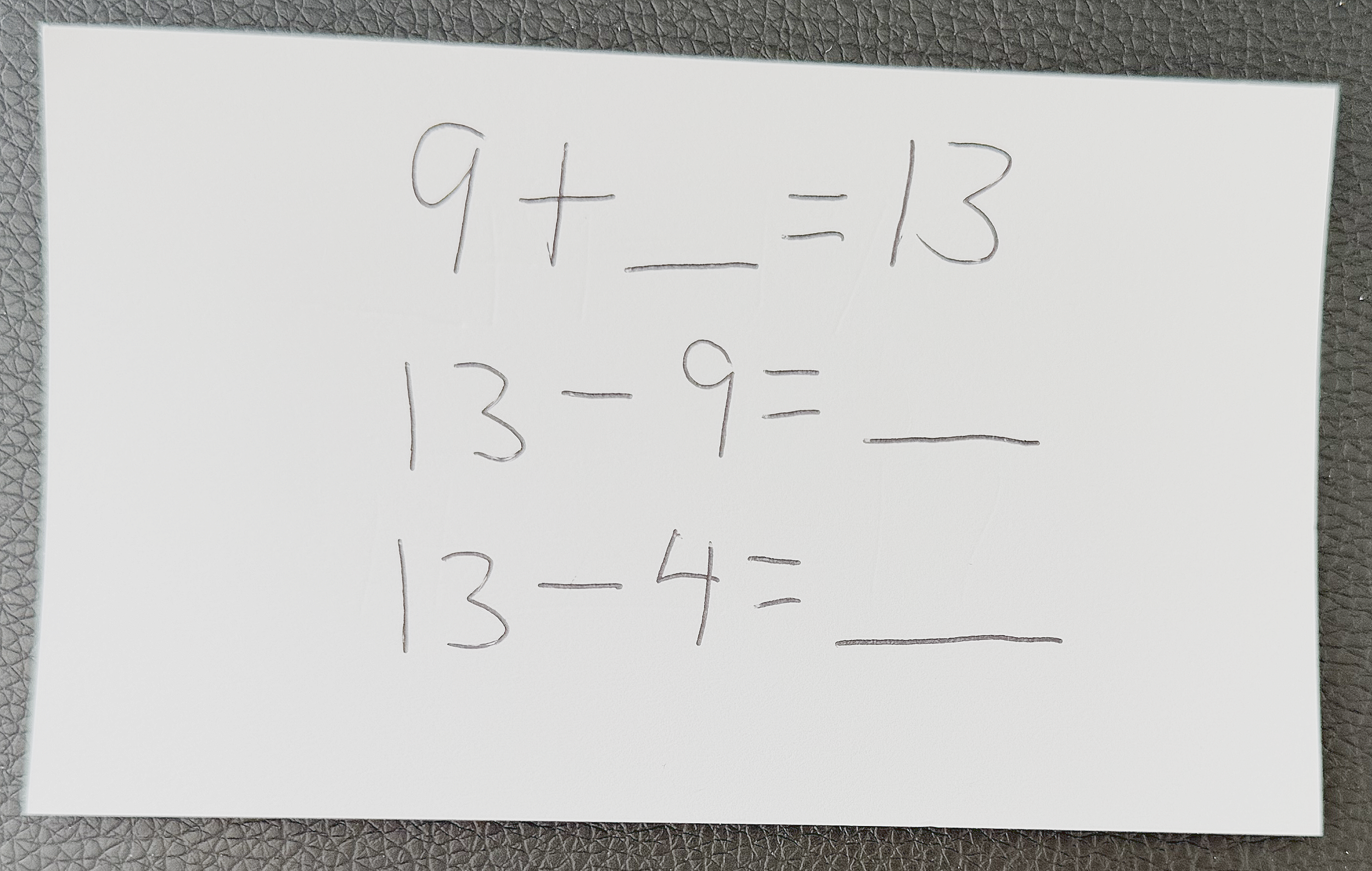
Knowing that 9 + 4 = 13 helped Connor solve two related subtraction problems: 13 − 9 = 4 and 13 − 4 = 9.
Another way to read a subtraction equation is the minuend plus what number gives you the subtrahend?
Parent Prompt if they see their child struggling with a subtraction calculation, e.g. 15 - 9.
9 plus what number is 15?
19. Using Basic Facts with Larger Numbers
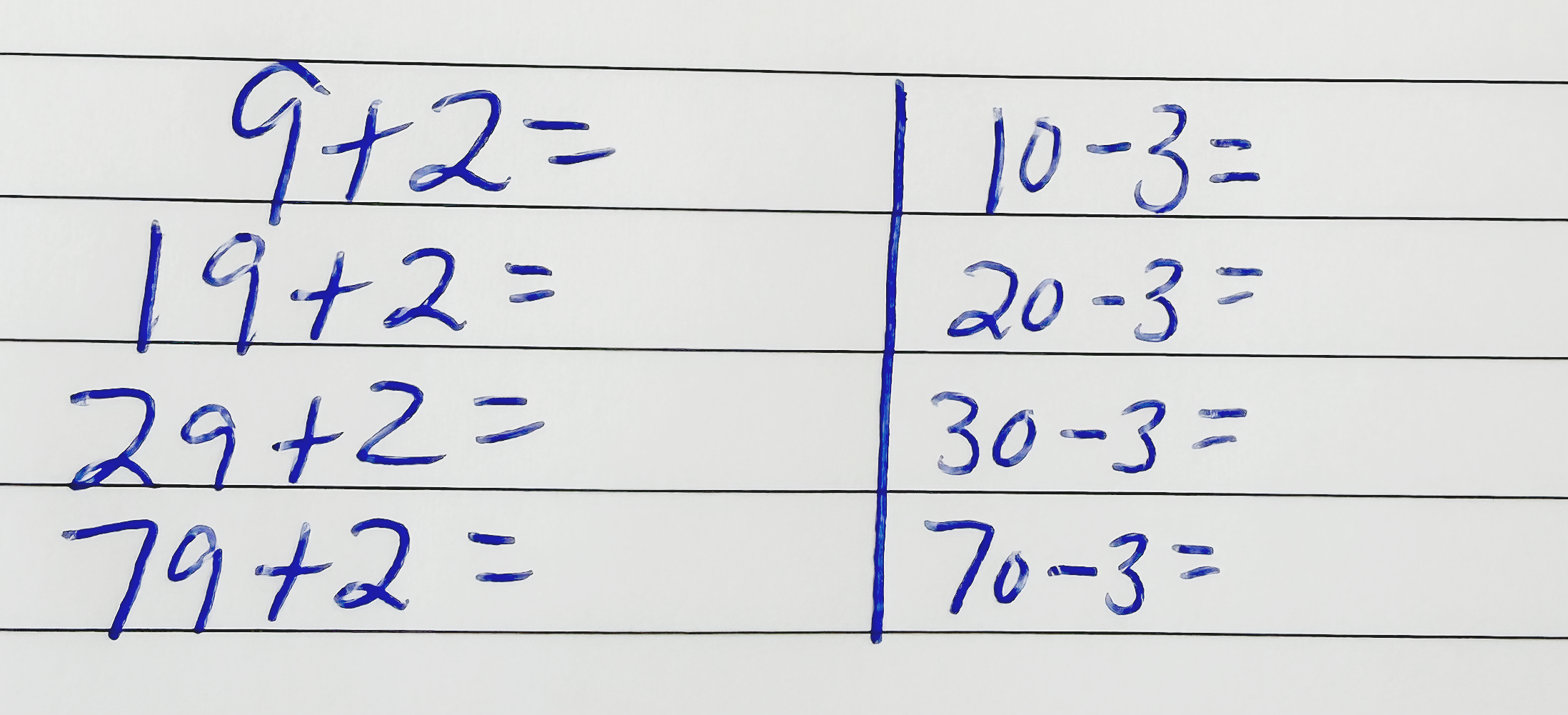
These short sequences helped Connor recognize how a familiar fact could help him solve problems with larger numbers.
For example, knowing 9 + 2 = 11 helped him work out 19 + 2, 29 + 2, and 79 + 2.
I let him discover the pattern through practice rather than pointing it out beforehand.
20. The Read, Draw, Write Process
21. Learning Money Exchanges with Life
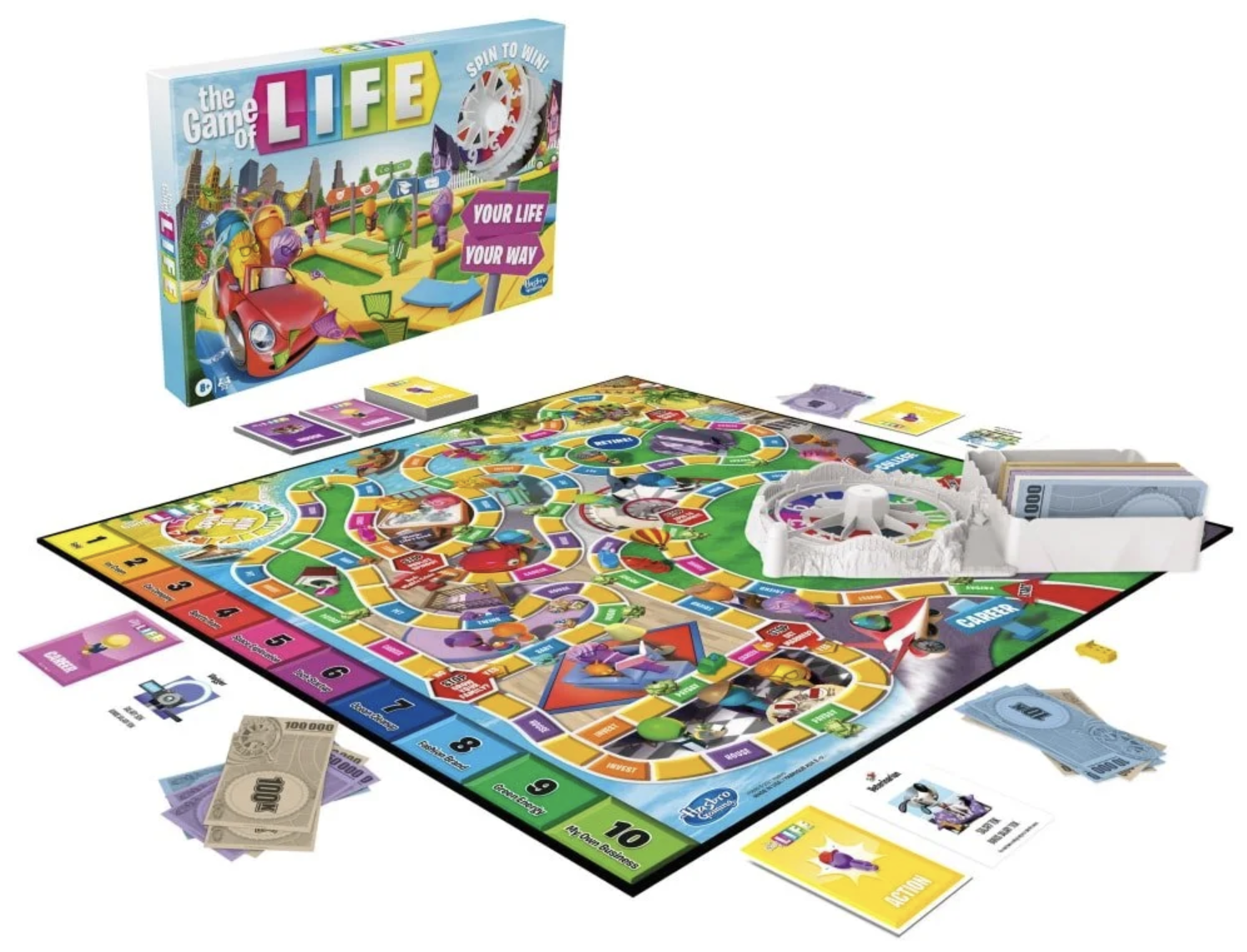
Connor’s enthusiasm for Life made the role of banker a natural opportunity to practice math. Handling the game’s money helped him add, subtract, make change, and exchange different denominations for equal amounts. What initially required effort gradually became easy through repeated play.
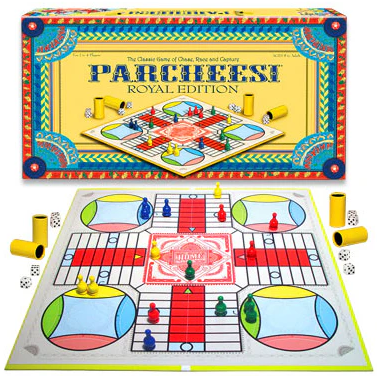
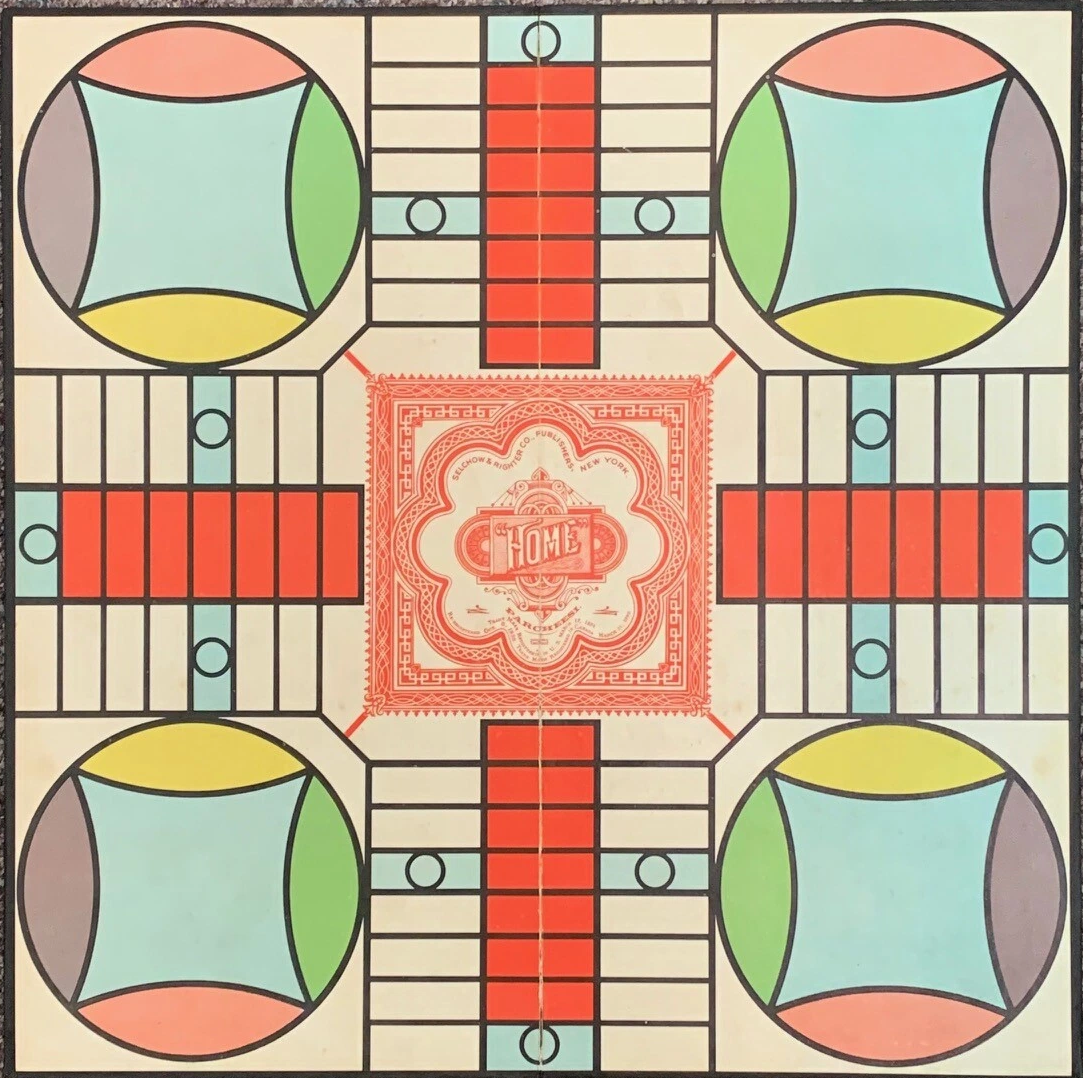
22. Arithmetic and Strategy with Parcheesi
Parcheesi gave Connor repeated practice recognizing dice patterns, adding, and counting on. Before rolling, I often asked what numbers he hoped to get—or hoped I wouldn’t get. These questions encouraged him to calculate distances, anticipate moves, and think strategically.
23. The Boy Who Loved Math
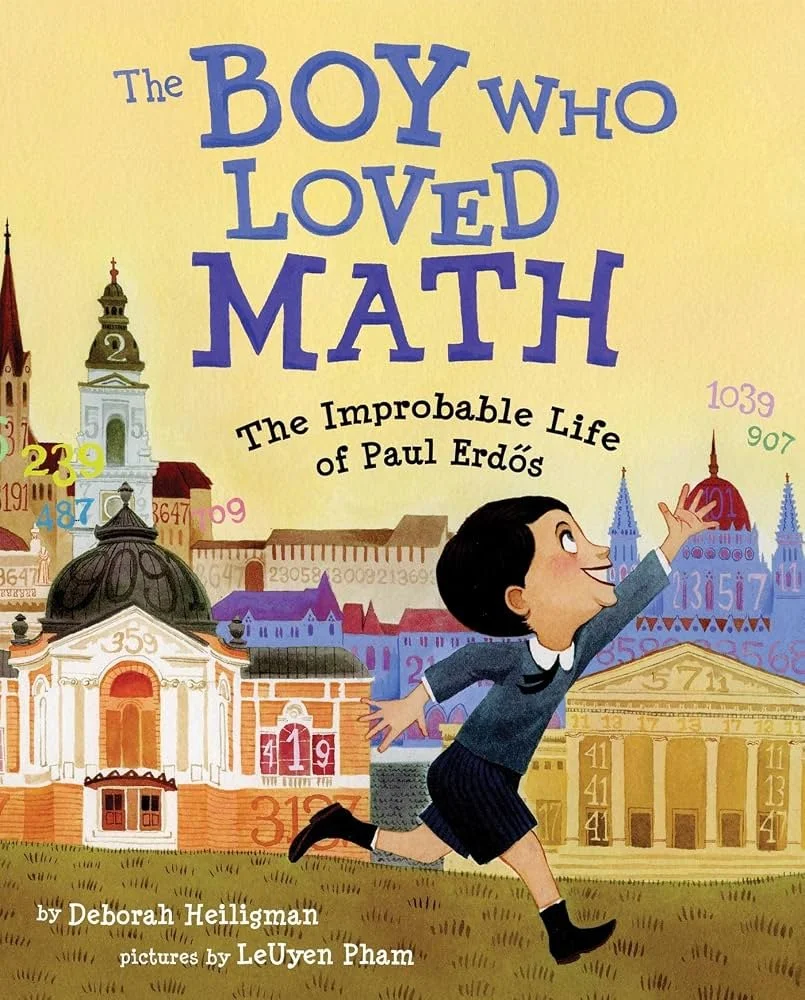
The Boy Who Loved Math: The Improbable Life of Paul Erdős became one of Connor’s favorite books
Its lively illustrations and mathematical ideas gave us plenty to notice and discuss while enjoying the story of a boy whose fascination with numbers became his life’s work.
24. Pencil Word Problem
Kimberly bought 5 pencils. Each pencil cost 25 cents. How much change did Kimberly get when she gave $2 to the cashier?
This problem shows how number fluency can make problem solving easier. A child might calculate the cost of five pencils and then subtract it from $2. A child comfortable with groups of 25 might recognize that $2 buys eight pencils, leaving three groups of 25 cents—or 75 cents—in change.
25. Singapore Math Intensive Practice
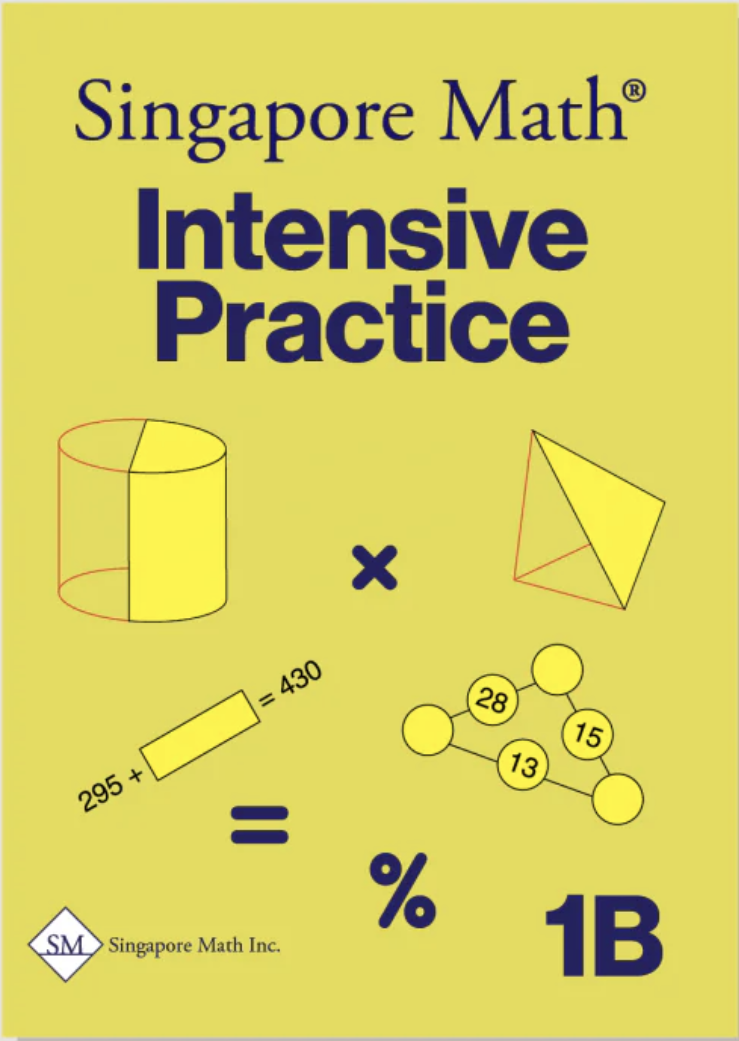
After Connor completed all basic second grade content, we revisited the topics through Singapore Math’s Intensive Practice series.
Its challenging problems helped him deepen his understanding and apply familiar skills in less familiar ways, without rushing ahead to the next grade.
In 20 years of working with Singapore Math curricula I’ve only encountered a handful of students who weren’t challenged by Intensive Practice problems on their grade level. This amazing series blends extra practice, challenging word problems, and brain teaser logic puzzles.
26. Spotting Arrays in Everday Life

While sitting on an airplane, Connor noticed that the speaker above us had 21 holes in each of ten rows.
He used 21 × 10 to calculate 210 holes—an opportunity to apply multiplication to something he noticed on his own.
27. Times Tables Sprints
These leveled Times Tables Sprints became an alternative to flashcards during Connor’s second-grade year.
Each Sprint progresses from simple to complex in a carefully designed sequence, helping children use facts they already know to solve those they find more challenging.
The topics follow a similar progression, beginning with one times table at a time, such as the threes. Later, Sprints combine two tables, then three, and finally four - for example, moving from twos and threes to twos, threes, fours, and fives.
By the time I returned to his old flashcards to see which facts still needed practice, Connor could recall all of them.